There are circumstances where government authorities require land for their public projects. This might include public transit, road widening projects, public utilities projects, schools and public works facilities. The required rights to the land have impacts on landowners to varying degrees—this is the process of expropriation.
With this in mind, we have developed this guide to provide a high level review of the process of expropriation in Ontario.1 This process can be a disconcerting topic for landowners. The Expropriations Act, R.S.O. 1990, c. E.26 provides a model for expropriation legislation which remains in many Canadian jurisdictions. Our review will cover the following:
- Introduction to expropriation.
- The expropriation process in Ontario.
- Compensation of the landowner.
- Legal costs and interests in expropriation.
A. Introduction to expropriation
Expropriation is one of the most powerful exercises of a public authority’s power. The term “expropriate” is defined in s. 1(1) the Expropriations Act as “the taking of land without the consent of the owner by an expropriating authority in the exercise of its statutory powers.” Expropriation is a complex, multi-step process that occurs when the government or a government-authorized body (including municipalities, the provincial government, the Ministry of Transportation, utility companies and universities) acquires private property for public use projects, such as public utilities, infrastructure or highway development. This process may take all of a property or a piece of the property, for example, an easement or subterranean rights.
While expropriation follows a litigation-type process, it is different from typical litigation because the expropriating authority is typically responsible for the reasonable costs of the landowner on a full indemnity scale. This includes legal and professional consulting fees.
Although expropriation may pave the way for new infrastructure, it can be a disruptive and financially challenging process for landowners, resulting in legal disputes between parties. As such, the process can be complex and difficult to understand. Therefore, a landowner should engage with counsel knowledgeable in expropriations as they can help property owners understand the process and protect their interests. While it is advisable to engage counsel as early as possible, doing so at any stage will provide value to the landowner.
B. The expropriation process in Ontario
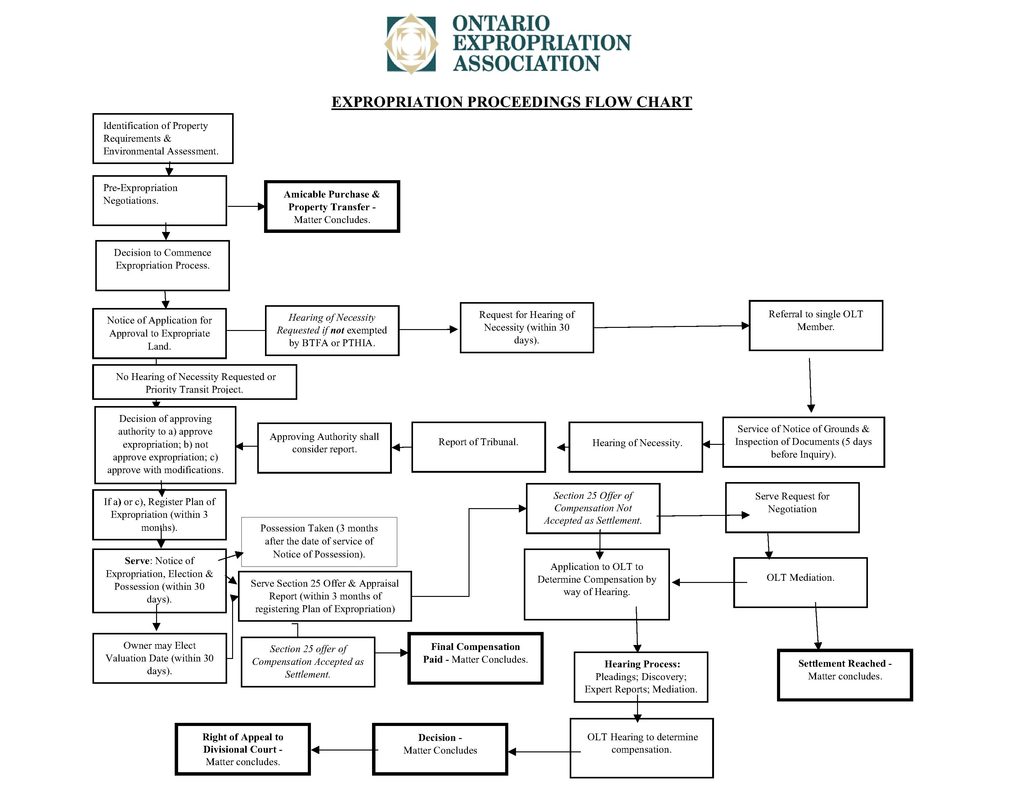
Expropriations in Ontario typically follow a process governed by the Expropriations Act. The following section walks through the key stages of an expropriation, from the first notice to the final appeal.
- Informal negotiations
Expropriating authorities will typically try to avoid the formal expropriation process by engaging in negotiations to purchase the interests in the property they require. The informal negotiations do not create any obligations for landowners. Where negotiations may arise, it is wise to engage with counsel and professional consultants at an early stage. Entering into an agreement at this stage can impact the landowner’s ability to participate in the formal expropriation process as detailed below.
- Notice of Application for Approval to Expropriate Land
The formal expropriation process starts when the expropriating authority serves a Notice of Application for Approval to Expropriate Land on the “registered owner(s)” of the property. The term “registered owner” is defined in s. 1(1) the Expropriations Act as “an owner of land whose interest in the land is defined and whose name is specified in an instrument in the proper land registry or sheriff’s office, and includes a person shown as a tenant of land on the last revised assessment roll.”
The Notice describes the nature of the taking and the purpose for the taking. A taking can be:
- full, covering the entire property;
- partial, covering only a portion of the property; or
- temporary, typically lasting a few years.
- The inquiry (formerly the Hearing of Necessity)
After being served with the Notice, a landowner has 30 days to request an inquiry. The inquiry asks whether the proposed expropriation is “fair, sound and reasonably necessary in the achievement of the objectives of the expropriating authority.” If an inquiry goes ahead, the inquiry officer delivers a written report to the authority with a non-binding recommendation. The expropriating authority then passes the report to the Approving Authority. After considering it, the Approving Authority will do one of three things:
- approve the expropriation without modifications;
- approve the expropriation with modifications; or
- refuse to approve the expropriation.
The Approving Authority must give written reasons for its decision and serve the decision on all parties within 90 days of receiving the inquiry officer’s report.
In practice, landowners seldom request inquiries, for two reasons:
- the outcome is only a recommendation, not a binding decision; and
- the Expropriations Act caps the costs a landowner can recover at a nominal CA$200.
At this point, generally landowners decide whether to challenge the expropriation in court. On a court challenge, the grounds are often limited to bad faith or illegality. These challenges are uncommon as it is a difficult test.
- Registration of the Plan of Expropriation
If the expropriation is approved, with or without modifications, the expropriating authority must register a Plan of Expropriation on title within ninety days of the approval. Registration has a significant legal consequence: legal title to the land vests in the expropriating authority when the plan is registered.
- Notice of Expropriation and Election and Notice of Possession
Notice of Expropriation and Election
Within thirty days of registering the plan, the expropriating authority must serve a Notice of Expropriation and Election on the registered owner. This includes everyone with an interest registered on title. The Notice does two things:
- it confirms that the land has been expropriated and that title has passed to the authority; and
- it lets the landowner choose the Valuation Date, which is the date as of which the market value of the land will be assessed.
The landowner has thirty days to make that choice. Otherwise, the landowner is deemed to have chosen the date the Plan of Expropriation was registered. The choice can materially affect compensation, especially in a moving real estate market, so it deserves careful thought and, ideally, advice.
Notice of Possession
A Notice of Possession is usually served together with the Notice of Expropriation and Election. It must set a possession date at least ninety days after the Notice of Possession is served. In practice, this typically means the authority cannot take possession for at least three months after the plan is registered.
- The Statutory Offer of Compensation (Section 25 Offer)
Unless the parties have already agreed on compensation, the expropriating authority must serve the registered owner with an offer of compensation under s. 25 of the Expropriations Act. The offer must be served within three months of registering the plan and before the authority takes possession. The offer must further be based on an appraisal report that assesses the market value of the land as of the Valuation Date and considers damages for injurious affection. The appraisal report must be included with the offer.
Offer A and Offer B
A Section 25 Offer has two parts, and the difference between them matters a great deal:
- Offer A is a full and final settlement. If the landowner accepts it, the stated amount resolves the claim completely.
- Offer B is a “without prejudice” offer of advance compensation. The landowner receives the stated amount now and keeps the right to negotiate or litigate for additional compensation.
A landowner who does not accept Offer A retains the right to pursue further compensation. That can happen through negotiation or by going to the Ontario Land Tribunal for mediation and, if necessary, a hearing. In practice, the vast majority of expropriation cases settle before a hearing.
The Ontario Land Tribunal and Divisional Court
If the parties cannot settle, the compensation claim is decided by the Tribunal. Mediation is available both before and after a claim is started. A Tribunal decision is not necessarily the end of the matter. Decisions and orders of the Tribunal in expropriation matters may be appealed to the Divisional Court, on a question of law, fact or both. On appeal, the Divisional Court may send the matter back to the Tribunal. It may also make any decision or order the Tribunal itself could have made.
C. Rights and remedies of the landowner
Compensation claims under the Expropriations Act
The Expropriation Act offers compensation to a landowner affected by the expropriation based on the following:
- Market value of the land: The market value of expropriated land is the amount the land might be expected to realize if sold in the open market. This figure is determined by an appraiser.
- Disturbance damages: Disturbance damages cover the reasonable costs incurred by the landowner as a natural and reasonable consequence of the expropriation. This includes expenses such as moving costs, business losses and replacement costs for items like signs or irrigation systems.
- Damages for injurious affection: Injurious affection refers to the impact on the remaining land not taken through the expropriation. It can also occur through the construction and impacts arising from projects on the expropriated land. This can include personal and business damages resulting from the construction or use of the project. This is typically quantified by an appraiser.
- Damages for any special difficulties in relocation: This category compensates for any unique challenges or additional costs the landowner faces in relocating due to the expropriation. This can include costs associated with finding a new location that meets specific needs or requirements of the landowner.
D. Legal and consulting costs in expropriation
Legal and consulting costs
The Expropriations Act is unique in that costs are considered part of the compensation to the landowner. Therefore, the indemnity principle applies to costs. This means that reasonable costs of the landowner are typically compensated on a full indemnity scale, subject to the provisions of s. 32 of the Expropriation Act. Costs under s. 32 include both legal and other consulting costs (such as an appraiser or a business loss valuator).
Under s. 32(1) of the Expropriations Act, where the amount to which a landowner is entitled following expropriation is determined to be 85% or more of the amount offered by the statutory authority, the Tribunal will order the payment of the reasonable legal and other costs incurred by the landowner for the purposes of determining the amount payable.
Even where a landowner is not awarded at least 85% of the amount offered, the Tribunal has discretion pursuant to s. 32(2) of the Expropriations Act to order the payment of a landowner’s reasonable legal and other costs incurred by the landowner. This often results in the payment of costs on a partial indemnity scale, although there are a couple of cases where the result was less favourable for a claimant. The presumption is that costs are paid by the expropriating authority.
Interest
The Expropriations Act also states that the landowner is entitled to be paid interest on:
- the portion of the market value of their interest in the land; and
- the portion of any allowance for injurious affection to which they are entitled to.
Interest is not typically awarded on disturbance damages. Interest is calculated at six percent annually from the date the landowner stops living on the land or making productive use of the land. It can be awarded from a date that predates the actual registration of an expropriation plan or the surrender of possession. Interest may be varied if there is found to be delay attributed to either party.
E. Conclusion
While the Expropriations Act itself is relatively short, as set out in this guide, expropriations follow a rather complex and involved process. While this guide aims to provide context for, and to simplify the process of, expropriation, please note that this is intended only as a reference guide for information purposes and as such, is not intended to be comprehensive and does not constitute legal or professional advice or a legal opinion of any kind.
Dentons continues to monitor and stay apprised of expropriation and related topics on housing, land use planning and municipal law on a regular basis and would be pleased to support you with any questions on this guide or any related matters you may have. Should you have an expropriation or related matter, please do not hesitate to contact Roberto Aburto, Alice Mihailescu, Kelly Duquette, Colin Poulin, Rachel Kuchma and Conor McCarthy.
[1] Keep in mind there is a federal expropriation regime pursuant to the Expropriation Act, RSC, 1985, c. E-21, however this article is focusing solely on the provincial regime.